
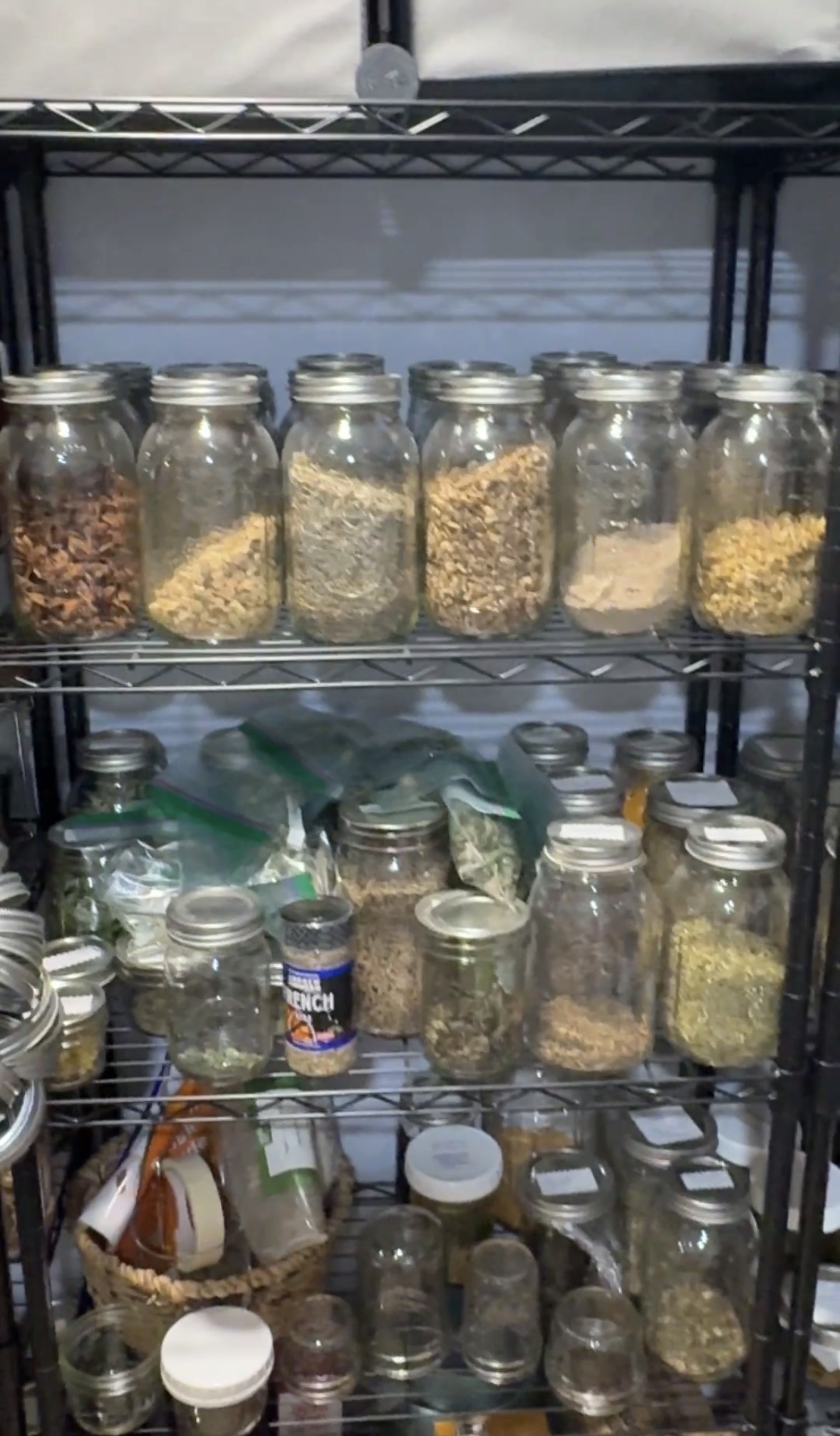
Over the years I’ve collected a fair number of herbs for both the kitchen and the apothecary. Some are familiar because I cook with them often. Others are used for tea or simple remedies. And a few, if I’m honest, have been sitting on the shelf waiting for me to take the time to really understand them.
So I decided to do exactly that.
This series is my personal Herb School — a way for me to slow down and study the herbs I already have, one plant at a time. Instead of trying to learn everything all at once or when I am about to use something ya know… I’m going to take one herb each week and spend a few minutes each day getting to know it better. Now I know a week is not enough time to know an herb inside and out… but I think its a good amount of time to introduce myself and get to know it a little better!
Not just reading about it, but actually working with it — tasting it, smelling it, brewing it, cooking with it, and preparing it in different ways.
By the end of each week I’ll have experienced that herb through multiple preparations and will have a much deeper understanding of how it behaves in both the kitchen and the apothecary.
If herbs interest you too, you’re more than welcome to follow along as I go.
How I’m Studying Each Herb
Each herb gets one full week of attention, with a small focus each day. The goal is to learn the plant from several angles — botanical, medicinal, culinary, and practical.
Here’s the outline I’ll be following each week.
Weekly Herb Study — Daily Outline
Day 1 — Identity + Infusion
Learn
- Common name
- Botanical name
- Plant family
- Parts used
- Basic plant description
- Brief historical context
Action
- Observe the herb closely
- Smell the dry herb
- Crush between fingers and smell again
- Taste a small pinch of the dry herb
- Make a tea (infusion)
- Smell and taste the tea
Journal
- What does the herb look like?
- What does the dry herb smell like?
- What does the dry herb taste like?
- How did the aroma change when steeped?
- How does the tea flavor compare to the dry herb?
- Did you notice any body response?
Day 2 — Herbal Actions + Decoction
Learn
- Primary herbal actions
- Energetics (warming or cooling)
- Moisture qualities (drying or moistening)
- Body systems affected
Action
- Make a decoction (simmer the herb)
- Observe color change while simmering
- Smell the steam
- Taste and compare to yesterday’s infusion
Journal
- What are the herb’s main actions?
- Does the flavor hint at those actions?
- How did simmering change the taste?
- Which tasted stronger: infusion or decoction?
- Does the herb feel warming or cooling?
Day 3 — Medicinal Uses + Tincture
Learn
- Traditional medicinal uses
- Modern herbal uses
- Conditions it supports
- When herbalists choose this herb
Action
- Start a small tincture jar
- Cover herb with alcohol
- Label herb name and date
- Shake the jar
Journal
- What conditions does this herb help most?
- When would I personally reach for it?
- Why might a tincture be useful for this herb?
- Did alcohol change the aroma?
Day 4 — Medicinal Deep Dive + Infused Honey
Learn
- Strength of the herb (gentle vs strong)
- Dosage considerations
- How herbalists combine it medicinally
- Comparable herbs
Action
- Make infused honey
- Stir thoroughly
- Smell the herb mixed with honey
- Taste a small amount
Journal
- How does honey change the flavor?
- What medicinal uses would honey preparations support?
- Would this herb help cough, throat irritation, or digestion?
Day 5 — Culinary + Syrup and/or Infused Oil
Learn
- Flavor profile
- Sweet vs savory uses
- Cultural cuisines that use the herb
- Flavor pairings
Action
Choose one preparation:
Option 1 — Herbal Syrup
- Simmer herb in water
- Strain
- Add sugar or honey
Option 2 — Infused Oil
- Place herb in jar
- Cover with oil
- Label and store
Then use the herb in a meal or drink.
Journal
- Did cooking change the herb’s flavor?
- What foods did it pair well with?
- Would this herb work better sweet or savory?
- Could I see myself cooking with this herb often?
Day 6 — Formulation + Compress
Learn
- Herbs that pair well medicinally
- Herbs that pair well for flavor
- Simple herbal formulas
Action
- Create a tea blend with 2–3 herbs from the cabinet
- Make a strong infusion
- Soak cloth and apply as a compress to skin
Journal
- What herbs did I combine and why?
- Did the blend improve the flavor?
- Where could a compress with this herb be useful?
- How did the compress feel on the skin?
Day 7 — Safety + Surprise Use
Learn
- Contraindications
- Drug interactions
- Who should avoid the herb
- Dosage cautions
Action
Explore an unexpected use for the herb. Examples could include:
- Bath soak
- Herbal steam
- Facial rinse
- Hair rinse
- Herbal vinegar
- Spice rub
- Herbal smoke cleansing
Journal
- Who should avoid this herb?
- What surprised me about this herb?
- What preparation did I like best?
- Would I keep this herb stocked?
- What was the most interesting thing I learned this week?
What This Approach Does
By the end of each week I will have experienced the herb through several different preparations:
- Dry tasting
- Infusion
- Decoction
- Tincture
- Honey infusion
- Syrup or oil
- Compress
- A creative or unusual preparation
Which means learning not just what the herb is, but how it behaves — its flavor, its chemistry, how it extracts into different preparations, and how it shows up in both medicine and food.
And that’s really the heart of this whole project.
Herbal knowledge doesn’t come from rushing through dozens of plants at once. It builds slowly, through familiarity and repeated experience.
So that’s what I’ll be doing here.
One herb.
One week.
And if you enjoy herbs as much as I do, you’re welcome to follow along as I continue learning my way through the cabinet.
Thanks for being here.
Till next time ~
— Angie
Leave a Reply